Spam calls have become a daily frustration for many South Africans. Whether it’s repeated missed calls from unfamiliar numbers or persistent telemarketing and scam attempts these calls can disrupt your day and pose real risks. The good news is that you don’t need to pay for expensive software or background checks to start identifying who is calling you.
This guide explains how South Africans can trace unknown spam calls for free using legitimate tools, public reporting platforms and safe practices. Everything here is written with local laws, networks and privacy rules in mind so you can protect yourself without crossing legal boundaries.
Why Trace Unknown Spam Calls?
Spam calls aren’t just irritating — they can be dangerous.
- Scams and fraud attempts may try to get your banking details or personal information over the phone.
- Robocalls and telemarketing can disrupt your day and waste your time.
- Without identifying who is calling you risk responding to fraudulent or spoofed numbers.
Tracing unknown calls helps you make informed decisions about answering, blocking or reporting suspicious numbers all without spending a cent.
The Independent Communications Authority of South Africa (ICASA) has repeatedly warned the public about scam calls where fraudsters impersonate officials or well-known organisations.
These scams often rely on urgency and fear to pressure people into sharing personal or financial information. ICASA has confirmed that legitimate institutions will never request PINs, OTPs or banking details over unsolicited phone calls.
Common Spam Call Scenarios in South Africa
Spam calls in South Africa often follow predictable patterns. Many involve fake banking alerts where callers claim there is suspicious activity on your account. Others involve prize notifications, debt collection threats or delivery problems that require “verification” of personal details.
Scammers use several tactics to prey on unsuspecting users:
- Bank or financial impersonation
- Prize or lottery scams
- Fake courier or delivery calls
- Telemarketing without consent
- Spoofed local numbers to appear familiar
Being familiar with these tactics makes it easier to recognise danger early.
Legitimate organisations do not pressure customers for sensitive information during unsolicited calls and they provide verifiable reference numbers or alternative contact methods.
How Spam Callers Hide Their Identity
One reason spam calls are so difficult to deal with is the use of number spoofing. Scammers can manipulate caller ID systems to make it appear as though they are calling from a local or trusted number. This makes people more likely to answer, especially if the number looks familiar or regional.
In South Africa, spoofed numbers frequently use local mobile prefixes or even landline-style numbers to appear legitimate. This means you cannot rely on the number format alone to judge whether a call is safe.
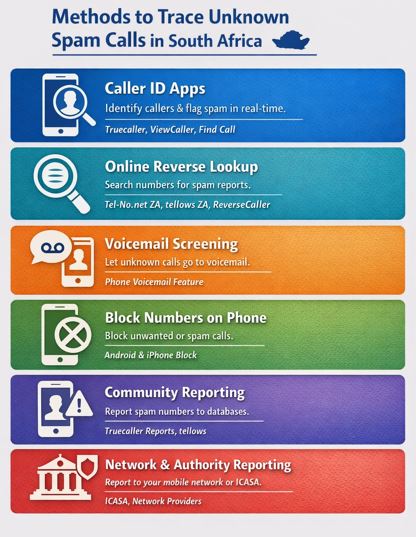
The following infographic is a useful quick view of the methods to trace unknown spam calls in South Africa:
1: Using Free Caller Identification Services
One of the most effective free ways to trace unknown spam calls in South Africa is by using caller identification databases that rely on community reporting.
Truecaller is one of the most widely used tools in the country and offers a free version that allows users to identify unknown callers and see whether a number has been flagged as spam.
Truecaller works by comparing incoming numbers against a massive global database built from user reports and public information.
When an unknown number calls the app may display a name, category or spam warning. South Africans can also use Truecaller’s website to perform a reverse phone lookup without installing the app. Although the information may be more limited.
According to Truecaller’s own data, millions of spam and scam calls are identified globally each day. With South Africa ranking among countries affected by high volumes of unsolicited calls.
2: Online Reverse Lookup Databases
Several online platforms exist where you can enter a phone number manually to get basic information or see if it has been flagged as spam:
- Tel-No.net ZA: A free unknown number query service that may show if a number has been reported as spam or scam.
- ReverseCaller South Africa: Lets you check numbers and view spam reviews shared by the community.
- Tellows ZA: Provides a community-generated score indicating whether a number is trustworthy or likely to be spam.
- JunkCall: A free tool that allows you to query unknown numbers without registration.
These services vary in detail but are convenient free options for gaining context on unknown callers.
This may also be of interest to you: Phone Number Search – Finding the Owner of a Cell Phone
Blocking Spam Calls on Android and iPhone
Most modern smartphones in South Africa include built-in features that allow users to block unwanted callers. On Android devices you can usually block a number directly from the call history by selecting the option to block or report it as spam.
Many Android phones also integrate Google’s spam detection system which automatically warns users about suspected spam calls.
On iPhones users can block a caller by opening the recent calls list, tapping the information icon next to the number and selecting the block option.
Apple also allows users to silence unknown callers. Which sends calls from numbers not in your contacts directly to voicemail.
Caller ID apps such as Truecaller can add an extra layer of protection by automatically blocking numbers that have been widely reported as spam.
Apps Beyond Truecaller
There are other free or freemium caller ID apps available in South Africa that can help identify or block spam:
- Find Call – Identify Caller ID for iPhone users.
- Phone Lookup – Block Spam Call apps on Apple devices.
- ViewCaller – Caller ID provides caller identification and blocking features.
These apps each pull data from community reports or global phone number databases to help identify spam calls before you pick up.
What to Do When You Receive a Spam Call
If you receive a call from an unknown number the safest first step is not to answer immediately. Letting the call go to voicemail gives you time to assess whether it is legitimate. Many spam callers do not leave messages while genuine callers usually do.
Once the call ends you can copy the number from your call log and search it using a free lookup tool.
If the number has been reported multiple times as spam or a scam it is best to avoid engaging with it at all. Returning calls to suspicious numbers can sometimes confirm that your number is active leading to even more spam.
Here’s how to quickly trace an unknown number:
- Don’t answer immediately. Let the call go to voicemail if possible.
- Copy the number from your call log.
- Paste the number into a reverse lookup tool like Truecaller, tellows ZA, or tel-no.net.
- Check for reports or spam labels.
- Decide your next step: block the number, return the call or report it.
This quick method gives context and helps you avoid answering potentially fraudulent calls.
The Role of Community Reporting Spam Calls
Free spam call tracing tools rely heavily on user participation.
When South Africans report spam numbers they help build databases that protect other users from the same callers. This shared reporting system is one of the most effective defences against large-scale spam operations.
Reporting a number only takes a few seconds but it can prevent hundreds or even thousands of other people from falling victim to scams.
Over time, heavily reported numbers are more likely to be automatically flagged or blocked by apps and networks.
Legal Considerations and POPIA Awareness
South Africa’s Protection of Personal Information Act (POPIA) governs how personal data may be collected, shared and used.
While POPIA does not prevent you from identifying unknown callers using public or community-based tools it does limit how personal information may be exploited.
You should never attempt to harass, threaten or publicly expose someone based on a phone number lookup.
Tracing spam calls should be used purely for personal safety, decision-making and reporting purposes. If a caller claims to represent a government department or financial institution it is always safer to contact that organisation directly using official contact details.
Reporting Spam Calls to Authorities and Networks
In addition to blocking and reporting numbers through apps, South Africans can report spam calls to their mobile service providers.
Many networks investigate repeated complaints and may take action against numbers that violate marketing or communication rules.
ICASA encourages the public to report fraudulent activity. Especially where callers impersonate regulators or public institutions.
While individual reports may not always lead to immediate results, large volumes of complaints help authorities identify patterns and issue broader warnings.
Tips to Stay Safe from Unknown Callers
- Never share OTPs, banking details, or personal info over an unsolicited call.
- Use voicemail screening — let potential spam callers leave a message first.
- Register with opt-out services (like the national opt-out database) to reduce telemarketing traffic.
- Update your phone’s software and security apps regularly.
These habits reduce your risk and strengthen your digital hygiene.
In Conclusion
Tracing unknown spam calls in South Africa does not require payment, advanced skills or access to restricted databases.
With free caller ID apps, community-driven lookup websites and sensible phone habits you can quickly assess whether an unknown caller is harmless or potentially dangerous.
By taking a few minutes to check and report suspicious numbers you protect not only yourself but also other South Africans dealing with the same problem. Staying informed, cautious and proactive remains the best defence against the growing issue of spam calls.